The Secret Weapon Hiring Managers Actually Want (But Nobody Brings)
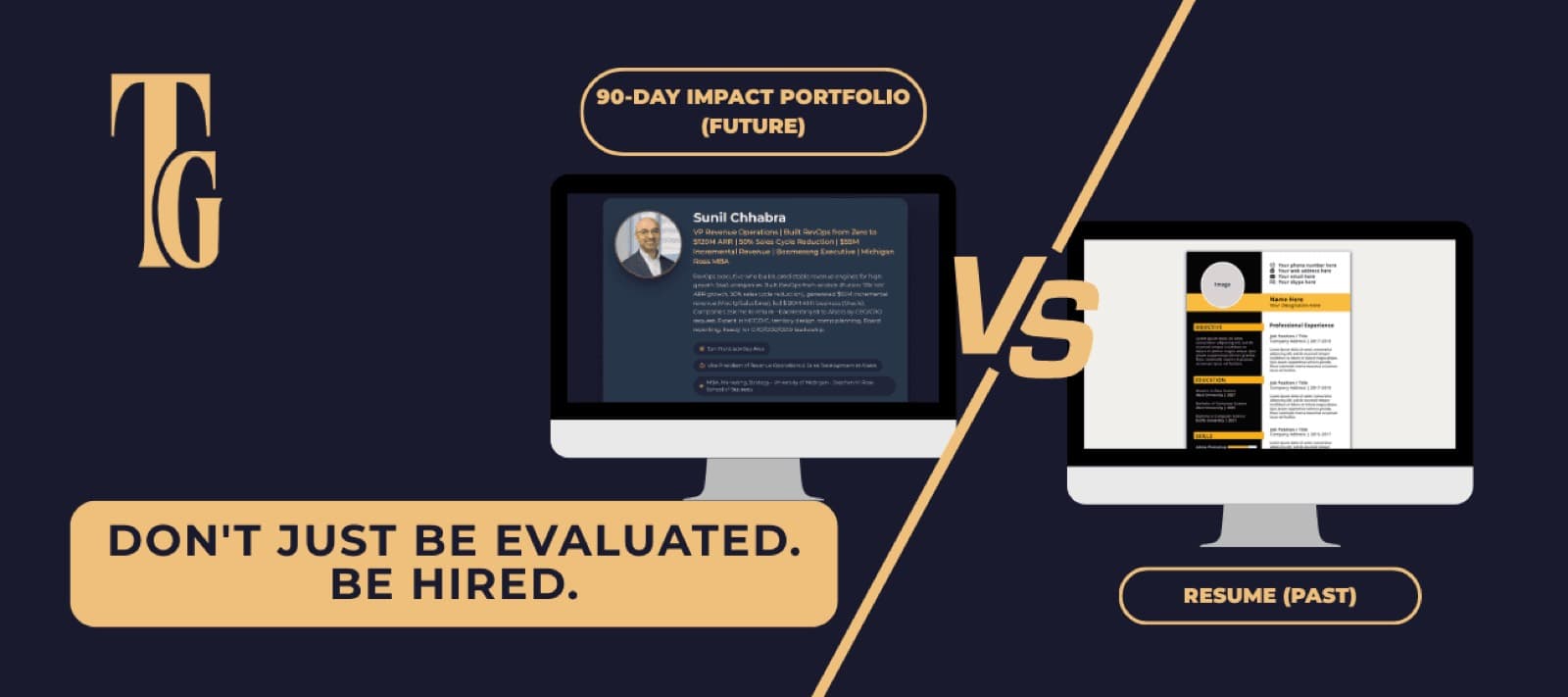
Most executives bring resumes. The ones who get offers bring 90-day plans.
The Secret Weapon Hiring Managers Actually Want (But Nobody Brings)
Most executives show up to interviews with a resume and talking points about their background.
The ones who get offers? They show up with a 90-day plan.
Here's the fundamental difference:
Resumes show what you've done in the past.
90-day plans show what you'll deliver in the future.
As career strategist Wonsulting puts it:
"A 30-60-90 day plan turns your interview from a Q&A session into a collaborative discussion about your future success."
That shift changes everything.
A 90-day plan reduces hiring risk. It demonstrates strategic thinking. It transforms the conversation from "Are you qualified?" to "Here's exactly what I'll deliver in your first quarter."
Instead of defending your credentials, you're presenting a business case for the value you'll create.
That's the difference between being evaluated and being hired.
Here's exactly why 90-day plans are the secret weapon hiring managers actually want—and how to build one that gets you hired faster.
Why Hiring Managers Desperately Want 90-Day Plans (But Never Ask)
Hiring managers at the $250K+ level face a difficult problem:
Five finalists all have similar credentials. Elite companies, strong results, impressive titles, relevant experience.
On paper, everyone looks qualified.
So how do they decide who to hire?
Most default to subjective assessments: "culture fit," "gut feel," "who I connected with best."
That's a terrible way to make a $300K+ hiring decision. And hiring managers know it.
What they actually want—but rarely receive—is concrete evidence of how you think and what you'll deliver.
A 90-day plan provides exactly that evidence.
What Hiring Managers Are Really Evaluating
Beyond credentials and experience, hiring managers are trying to answer four critical questions:
Question 1: Can this person diagnose our specific challenges accurately?
They need someone who can assess the situation correctly, not just bring a generic playbook.
Your 90-day plan proves this by demonstrating your analysis of their specific situation.
Question 2: How does this person prioritize when everything seems urgent?
They need strategic thinking, not just hard work.
Your 90-day plan proves this by showing clear priorities and sequencing for your first quarter.
Question 3: Will this person deliver results quickly or need 6 months to "get up to speed"?
They need fast impact, not a long learning curve.
Your 90-day plan proves this by outlining specific deliverables and timelines.
Question 4: Does this person understand how to build momentum and credibility?
They need someone who can gain trust and support quickly.
Your 90-day plan proves this by showing you understand organizational dynamics and stakeholder management.
These four questions can't be answered by your resume.
But your 90-day plan answers all four—before they even ask.
Why Hiring Managers Don't Request 90-Day Plans
If 90-day plans are so valuable, why don't hiring managers explicitly request them?
Three reasons:
Reason 1: They don't want to seem demanding
Asking candidates to create a detailed plan feels like too much work to request. They don't want to scare people away.
Reason 2: They assume no one will do it
In their experience, 95%+ of candidates won't invest this level of effort. So why ask?
Reason 3: They don't know what they're missing
Most hiring managers have never received a proper 90-day plan from a candidate. They don't realize how valuable it would be.
But here's what happens when you bring one anyway:
Hiring manager's internal reaction:
"Holy shit. This person has done more strategic thinking about our business in two weeks than some candidates do in six months of employment. This is exactly the level of preparation and strategic thinking we need."
You've just differentiated yourself from every other candidate.
Not by having better credentials. By demonstrating better strategic thinking.
What Makes a 90-Day Plan Different from a Resume
Let's be absolutely clear about the distinction:
What Your Resume Shows
Content focus:
- Where you've worked (past)
- What titles you've held (past)
- What you've accomplished (past)
- What skills you've developed (past)
- Who you've managed (past)
What it proves:
- You have relevant experience
- You've delivered results before
- You meet the basic qualifications
- You have the right background
What it doesn't show:
- How you think strategically
- What you'll do in this specific role
- How you analyze unique situations
- What value you'll create here
What Your 90-Day Plan Shows
Content focus:
- Analysis of their current state (present)
- Your strategic priorities (future)
- Specific actions you'll take (future)
- Expected outcomes (future)
- How you'll measure success (future)
What it proves:
- You think strategically about their business
- You've done deep research on their situation
- You can prioritize and sequence initiatives
- You understand organizational dynamics
- You can project realistic outcomes
What it uniquely demonstrates:
- Executive-level strategic thinking
- Company-specific understanding
- Concrete action orientation
- Results-focused accountability
- Collaborative problem-solving approach
The fundamental difference:
Your resume is defensive: "Here's proof I'm qualified"
Your 90-day plan is offensive: "Here's how I'll create value"
Defensive positioning gets you evaluated. Offensive positioning gets you hired.
The Psychology: Why 90-Day Plans Win Interviews
The power of 90-day plans isn't just tactical—it's deeply psychological.
Psychological Advantage 1: Risk Reduction
The hiring manager's fear:
"What if this person can't actually do the job? What if they struggle to adapt? What if I'm wrong about them?"
Every $300K+ hire carries significant risk. Get it wrong and you've:
- Wasted 6-12 months
- Damaged team morale
- Set back strategic initiatives
- Put your own judgment in question
How 90-day plans reduce perceived risk:
When you present a detailed plan showing exactly what you'll do and how you'll measure success, you're essentially saying:
"Here's my thinking process. Here's my approach. Here's how I'll adapt to your specific situation. You can see exactly how I work before you hire me."
This transparency reduces the hiring manager's anxiety dramatically.
They're not gambling on your potential. They're seeing your strategic approach before making the investment.
Psychological Advantage 2: Already Acting Like Their Executive
The standard candidate approach:
"I'd love to learn about the role. Tell me about the challenges. What would success look like?"
Translation: "I'm waiting for you to tell me what to do."
The 90-day plan approach:
"I've researched your business and identified three priority challenges. Here's my strategic approach to addressing them in the first quarter. Here's what success looks like at 30, 60, and 90 days."
Translation: "I'm already thinking and acting like your executive."
The psychological shift is massive.
You're not asking about the role—you're already thinking about how to succeed in it.
You're not waiting for direction—you're proposing strategic direction.
You're not positioning as candidate—you're positioning as their executive who happens to not be employed yet.
Hiring managers respond to people who are already functioning at the level they need.
Psychological Advantage 3: Collaborative Discussion vs Interrogation
Standard interview dynamic:
Hiring Manager: "Tell me about a time you handled a difficult situation."
Candidate: [Tells story hoping it's what they want to hear]
Hiring Manager: "Walk me through your management philosophy."
Candidate: [Tries to say the right things]
This is an interrogation. You're being tested. Power dynamic is completely one-sided.
90-day plan interview dynamic:
You: "Let me walk you through my 90-day plan. I've identified three strategic priorities based on my research. Let me know if my analysis aligns with what you're seeing internally."
Hiring Manager: "Yes, that's accurate. Tell me more about your approach to priority two."
You: "Here's my thinking on sequencing and quick wins..."
Hiring Manager: "What about the challenge with [specific internal factor]?"
You: "Good point. Here's how I'd adapt the approach to account for that..."
This is a strategic discussion between peers. You're solving problems together. Power dynamic is collaborative.
The quote from Wonsulting captures this perfectly:
"A 30-60-90 day plan turns your interview from a Q&A session into a collaborative discussion about your future success."
Q&A sessions evaluate candidates. Collaborative discussions build partnerships.
Psychological Advantage 4: Commitment and Consistency
The psychological principle:
When people take a position or express an opinion, they feel psychological pressure to act consistently with that position.
How this works with 90-day plans:
When a hiring manager engages with your 90-day plan—asks questions, suggests modifications, discusses your approach—they're mentally committing to your candidacy.
They're not just evaluating you anymore. They're collaborating with you on how you'll succeed in the role.
This creates psychological momentum toward hiring you.
Every minute they spend discussing your plan is another minute they're imagining you in the role, solving their problems, delivering results.
By the end of the interview, they're not asking "Should we hire this person?"
They're asking "When can this person start?"
The 4 Core Components Every 90-Day Plan Needs
A winning 90-day plan has four essential sections that demonstrate strategic thinking while remaining concrete and actionable.
Component 1: Situation Analysis (The Diagnostic)
Purpose: Prove you understand their specific challenges, not generic industry issues
What to include:
Current state assessment:
- Where the team/function/company is today
- Key challenges identified through research
- Gaps between current state and desired outcomes
- Root causes of current challenges (your hypotheses)
Example situation analysis:
"Based on my research and industry benchmarks, I've identified three primary challenges facing your revenue operations:
-
Deal velocity declining as you move upmarket: Average sales cycle has extended from 4.5 months to 6.8 months over the past year as you pursue enterprise accounts (per your investor updates).
-
Inconsistent execution across growing team: Team has grown from 12 to 35 reps in 18 months, but quota attainment has dropped from 78% to 61%, suggesting process and enablement gaps.
-
Forecast accuracy issues: Public comments in Q3 earnings call acknowledged forecast accuracy challenges, which typically stem from unclear qualification criteria and pipeline management.
These challenges are common when companies scale from $20M to $50M ARR, which is your current phase based on Crunchbase data."
Why this works:
- Shows you've done actual research (specific numbers, sources)
- Identifies real challenges (not generic problems)
- Demonstrates pattern recognition (you've seen this before)
- Positions you as strategic advisor (diagnosing, not just describing)
What NOT to do:
❌ Generic analysis that could apply to any company
❌ Surface-level observations without insight
❌ Criticism without constructive framing
❌ Assumptions without research basis
Component 2: Strategic Priorities (The What)
Purpose: Show you can prioritize and focus on highest-impact initiatives
What to include:
Your 3-5 strategic priorities for first 90 days:
- What you'll focus on (not everything, but critical items)
- Why these priorities matter most now
- How they connect to business goals
- Sequencing and interdependencies
Example strategic priorities:
"Based on this analysis, I'd focus on three strategic priorities in the first 90 days:
Priority 1: Sales Process Optimization (Weeks 1-6)
Focus on deal velocity and consistency. This is the foundation—we can't scale effectively until the core process is sound.
Priority 2: Team Enablement and Coaching (Weeks 4-10)
Once process is clear, ensure the team can execute it consistently. This drives quota attainment improvement.
Priority 3: Forecasting and Pipeline Discipline (Weeks 8-12)
With improved process and execution, implement rigorous pipeline management and forecasting methodology.
These priorities build on each other: process clarity enables better coaching, which drives better pipeline discipline."
Why this works:
- Shows strategic thinking (prioritization, not trying to fix everything)
- Demonstrates sequencing (understanding what must come first)
- Explains the logic (helps them see your reasoning)
- Connects to business goals (revenue growth, predictability)
What NOT to do:
❌ Listing too many priorities (shows lack of focus)
❌ Generic goals without specificity
❌ Priorities that don't address diagnosed challenges
❌ No explanation of priority ranking
Component 3: Action Plan (The How)
Purpose: Demonstrate you can translate strategy into concrete actions
What to include:
Specific activities for each 30-day increment:
Days 1-30: Discovery and Quick Wins
- Who you'll meet with (by role, not by name)
- What data you'll analyze
- What you'll learn and validate
- Early quick wins you'll target
- Deliverable: Diagnostic report with findings
Days 31-60: Strategy and Implementation
- Strategic initiatives you'll launch
- Changes you'll implement
- Resources you'll need
- Stakeholders you'll align
- Deliverable: Strategic plan with roadmap
Days 61-90: Execution and Momentum
- Results you'll drive
- Metrics you'll track
- Team you'll develop
- Systems you'll establish
- Deliverable: Progress report with outcomes
Example action plan (Days 1-30):
"Weeks 1-2: Data-Driven Diagnostic
- Analyze last 100 deals: win/loss patterns, cycle time by stage, conversion rates
- Review current sales process documentation and identify gaps
- Shadow 10 sales calls across rep experience levels
- Interview top 3 performers: what's working and why
- Deliverable: Data analysis highlighting specific bottlenecks
Weeks 3-4: Qualitative Assessment
- Conduct 1-on-1s with all 35 reps: challenges, obstacles, needs
- Meet with customer success team: handoff process, expectations alignment
- Interview 5 recent buyers: what influenced their decision, what slowed them down
- Present initial findings to leadership team
- Deliverable: Comprehensive diagnostic report with top 3 recommended fixes
Quick Wins (Days 1-30):
- Implement weekly pipeline review with standard format (Week 2)
- Create simple qualification checklist for early stages (Week 3)
- Launch peer learning sessions with top performers (Week 4)
Expected outcome: 10-15% improvement in pipeline visibility and early-stage qualification within first 30 days."
Why this works:
- Extremely specific (not vague goals)
- Shows diagnostic before solutions (smart sequencing)
- Includes quick wins (builds momentum)
- Realistic timeline (not overpromising)
- Clear deliverables (accountability)
What NOT to do:
❌ Vague activities like "learn the business"
❌ Unrealistic promises (30% revenue increase in 30 days)
❌ Only strategy without tactical execution
❌ No specific deliverables or checkpoints
Component 4: Success Metrics (The Measurement)
Purpose: Show you understand accountability and how to measure progress
What to include:
Specific metrics for each phase:
30-day metrics:
- Leading indicators you'll track
- Early progress measures
- What success looks like at day 30
60-day metrics:
- Strategic initiative progress
- Team performance improvements
- Business impact beginning to show
90-day metrics:
- Business outcomes achieved
- ROI on your first quarter
- Foundation laid for ongoing success
Example success metrics:
"30-Day Success Metrics:
- Diagnostic report completed and presented to leadership
- 100% of sales team interviewed and individual development plans drafted
- Pipeline review process implemented with 90%+ attendance
- Early-stage qualification improved by 10-15% (measured by stage 1→2 conversion)
60-Day Success Metrics:
- Sales process documentation updated and rolled out to entire team
- Coaching framework implemented with biweekly 1-on-1 structure
- Win rate improvement visible in data (targeting 3-5 percentage point increase)
- Average sales cycle reduction of 10-15% (from 6.8 months toward 6.0 months)
90-Day Success Metrics:
- Quota attainment improvement from 61% to 70%+ across team
- Forecast accuracy improvement to 85%+ (from current ~70%)
- Deal velocity improvement: 15-20% reduction in sales cycle
- Pipeline coverage improvement to 3.5x quota (from current ~2.8x)
- Clear roadmap established for Q2 scaling initiatives
ROI Projection:
Conservative estimate: 15% improvement in key metrics translates to ~$2M incremental revenue impact over 12 months, with 8:1 ROI on my total compensation package."
Why this works:
- Specific numbers (not vague "improvements")
- Mix of leading and lagging indicators
- Realistic but meaningful targets
- Clear accountability checkpoints
- ROI framing (business case thinking)
What NOT to do:
❌ No metrics at all
❌ Metrics impossible to measure or verify
❌ Only vanity metrics (activity, not outcomes)
❌ Unrealistic targets that destroy credibility
How to Build Your 90-Day Plan (The Process)
Creating an effective 90-day plan requires research, strategic thinking, and careful construction. Here's the systematic process:
Step 1: Deep Research (4-6 hours)
Company research:
- Website, blog, press releases thoroughly
- Recent news mentions and media coverage
- Financial data if public or disclosed
- Product/service positioning and messaging
- Competitive landscape and positioning
Industry and market research:
- Industry trends affecting this company
- Competitive dynamics and market forces
- Regulatory or technology changes
- Customer preferences and expectations
People research:
- Leadership team backgrounds and priorities
- Company culture indicators (Glassdoor, LinkedIn)
- Recent hires and departures (organizational signals)
- Board composition if available
Challenge identification:
- What problems do they likely face?
- What gaps can you identify from research?
- What opportunities exist?
- What risks do they need to manage?
Sources to use:
- LinkedIn (company page, employee profiles)
- Crunchbase (funding, growth, investors)
- Company blog and resources
- Industry publications
- Competitor websites and positioning
- Glassdoor employee reviews
- Podcast interviews with leadership
- Conference presentations or webinars
Step 2: Strategic Analysis (2-3 hours)
Synthesize your research:
- What are the 3-5 biggest challenges?
- What's the root cause of each challenge?
- Which challenges are most urgent?
- Which have highest business impact?
- What's realistic to address in 90 days?
Develop your strategic priorities:
- What 3-4 things matter most in first 90 days?
- How do they sequence logically?
- What dependencies exist?
- What quick wins can build momentum?
- What foundations must be laid?
Pressure-test your thinking:
- Is this specific to them or generic?
- Is this realistic in 90 days?
- Am I making unwarranted assumptions?
- Do I have evidence for my analysis?
- Would an insider find this credible?
Step 3: Plan Development (3-4 hours)
Write your situation analysis:
- Current state description
- 3-5 key challenges identified
- Root causes and context
- Connection to business goals
Define your strategic priorities:
- 3-4 priority areas for 90 days
- Rationale for each priority
- How they connect and sequence
- Expected business impact
Build your action plan:
- Days 1-30: Specific activities and deliverables
- Days 31-60: Strategic initiatives and outcomes
- Days 61-90: Results and momentum building
- Quick wins throughout
Establish success metrics:
- 30-day measurement points
- 60-day progress indicators
- 90-day outcome targets
- ROI projection
Step 4: Document Creation (2-3 hours)
Format options:
Option A: Presentation slides (15-20 slides)
- Clean, professional design
- Visual hierarchy and flow
- Mix of text, frameworks, charts
- Can present live or share as PDF
Option B: Written document (5-8 pages)
- Professional formatting
- Clear section headers
- Bullet points and frameworks
- Can email as PDF
Option C: Web-based portfolio
- Mobile-friendly format
- Easy sharing via link
- Can update anytime
- Professional impression
Design principles:
- Clean and professional (not over-designed)
- Easy to scan and digest
- Visual elements support content
- Consistent formatting throughout
Step 5: Refinement and Practice (1-2 hours)
Review and refine:
- Read through as if you're the hiring manager
- Check for gaps in logic
- Verify all specifics are accurate
- Ensure realistic and credible
- Polish language and flow
Practice presenting:
- Can you walk through it in 15 minutes?
- Can you explain your reasoning clearly?
- Are you ready for questions?
- Can you adapt based on feedback?
Get feedback:
- Share with trusted advisor or mentor
- Get perspective from someone in similar role
- Incorporate constructive feedback
- Final polish
Total time investment: 12-18 hours
Return: Tool that dramatically increases offer probability
How to Deploy Your 90-Day Plan in Interviews
Creating the plan is half the battle. Deploying it effectively is the other half.
Deployment Strategy 1: After First Interview
The approach:
Send your 90-day plan as follow-up after initial interview:
"Hi [Name],
Thank you for the great conversation today about the [role] opportunity. Our discussion about [specific challenge] confirmed my initial research about [situation].
I've prepared a detailed 90-day plan outlining my strategic approach to [their priority]: [link to plan]
It includes my situation analysis, strategic priorities, action plan for first quarter, and success metrics.
Happy to discuss any aspect of the plan. Looking forward to continuing our conversation.
Best,
[Your name]"
Why this works:
- Shows serious commitment (invested significant time)
- Provides substance for internal discussions
- Differentiates you from other candidates
- Gives them something to forward to stakeholders
- Demonstrates strategic thinking they couldn't see in resume
Deployment Strategy 2: During Second/Third Interview
The approach:
"I've prepared a detailed 90-day plan that outlines my strategic approach to the challenges we discussed. Would it be helpful if I walk through it, or would you prefer a more conversational format?"
(They'll always say "Let's see the plan")
Then present it professionally:
- Walk through your analysis (5 minutes)
- Present your priorities and rationale (5 minutes)
- Highlight key actions and deliverables (5 minutes)
- Open for discussion and questions (15-30 minutes)
Why this works:
- You control the conversation flow
- You demonstrate presentation skills
- You create collaborative discussion
- You show executive communication capability
- You make their evaluation decision easier
Deployment Strategy 3: Final Round Presentation
The approach:
Use your 90-day plan as your formal presentation to leadership team or board:
"Thank you for the opportunity to present my vision for the [role]. I've developed a comprehensive 90-day plan that addresses the priorities you've shared..."
Present to the group:
- Professional delivery
- Clear visual support
- Strategic depth
- Openness to feedback and discussion
- Confidence and executive presence
Why this works:
- Only candidate with prepared strategic presentation
- Shows you're ready to start on day one
- Demonstrates leadership capability
- Makes internal decision process easy
- Impossible to forget or overlook
What to Expect: Typical Responses
Response 1: "This is incredibly thorough"
Translation: "You're operating at a level beyond other candidates"
Response 2: "Can I share this with [CEO/team/board]?"
Translation: "I'm internally selling your candidacy using your materials"
Response 3: "Let me give you some context on [specific factor]..."
Translation: "I'm collaborating with you, not just evaluating you"
Response 4: "How did you develop this analysis?"
Translation: "I'm impressed and want to understand your process"
Response 5: "When could you start?"
Translation: "We want to hire you"
Common Mistakes to Avoid
Mistake 1: Making it too generic
Generic 90-day plans that could apply to any company in your industry don't demonstrate strategic thinking.
The fix: Make it intensely specific to their situation, using actual research and concrete details.
Mistake 2: Overpromising results
"I'll increase revenue 50% in 90 days" destroys credibility immediately.
The fix: Be conservative and realistic. Show understanding that diagnosis comes before solutions.
Mistake 3: Ignoring organizational dynamics
Plans that assume you can change everything immediately show naivety.
The fix: Demonstrate understanding of stakeholder management, change management, and organizational realities.
Mistake 4: Too long or too complex
40-page detailed plans overwhelm rather than impress.
The fix: Keep it focused and digestible. 10-20 pages or slides maximum.
Mistake 5: No specific metrics
Plans without measurable outcomes don't show accountability.
The fix: Include specific, measurable success criteria for each phase.
Mistake 6: Creating it too early
Building a detailed plan before your first interview means you're guessing.
The fix: Do initial research, but refine the plan based on what you learn in early interviews.
Mistake 7: Not practicing presentation
Having a great plan but fumbling the presentation wastes the opportunity.
The fix: Practice presenting it clearly and confidently in 15 minutes.
The Bottom Line: The Secret Weapon
Most executives show up to interviews with a resume and hope their background speaks for itself.
The ones who get offers? They show up with a 90-day plan that demonstrates exactly what they'll deliver.
Here's why 90-day plans are the secret weapon hiring managers actually want:
They reduce hiring risk by showing your strategic approach before they invest $300K+
They demonstrate strategic thinking in a way resumes never can
They shift the conversation from "Are you qualified?" to "Here's how I'll succeed"
They create collaborative discussion instead of one-sided evaluation
They differentiate you immediately because 95% of candidates don't bring one
As Wonsulting captured perfectly:
"A 30-60-90 day plan turns your interview from a Q&A session into a collaborative discussion about your future success."
Q&A sessions evaluate candidates.
Collaborative discussions build partnerships.
That's the difference between being evaluated and being hired.
The 4 components every 90-day plan needs:
- Situation Analysis: Prove you understand their specific challenges
- Strategic Priorities: Show you can focus on highest-impact initiatives
- Action Plan: Demonstrate you can translate strategy into execution
- Success Metrics: Show accountability and measurement thinking
The investment: 12-18 hours to research, analyze, and build your plan
The return: The secret weapon that transforms interviews and dramatically increases offer probability
Most executives compete on credentials. You'll compete on strategic thinking.
That's the competitive advantage that wins $300K+ offers.
Ready to Build Your 90-Day Impact Portfolio?
The 90-Day Impact Portfolio provides everything you need: structure, examples, templates, and strategic frameworks for creating the 90-day plans that close executive offers.
Get The 90-Day Impact Portfolio and build the secret weapon hiring managers actually want.
Contact Me to discuss your specific situation and get personalized guidance.
Join My Newsletter for weekly executive job search strategies and insights.
Written by
Bill Heilmann