How to Become a Domain Translator: The $500K Career Move Most Executives Are Missing
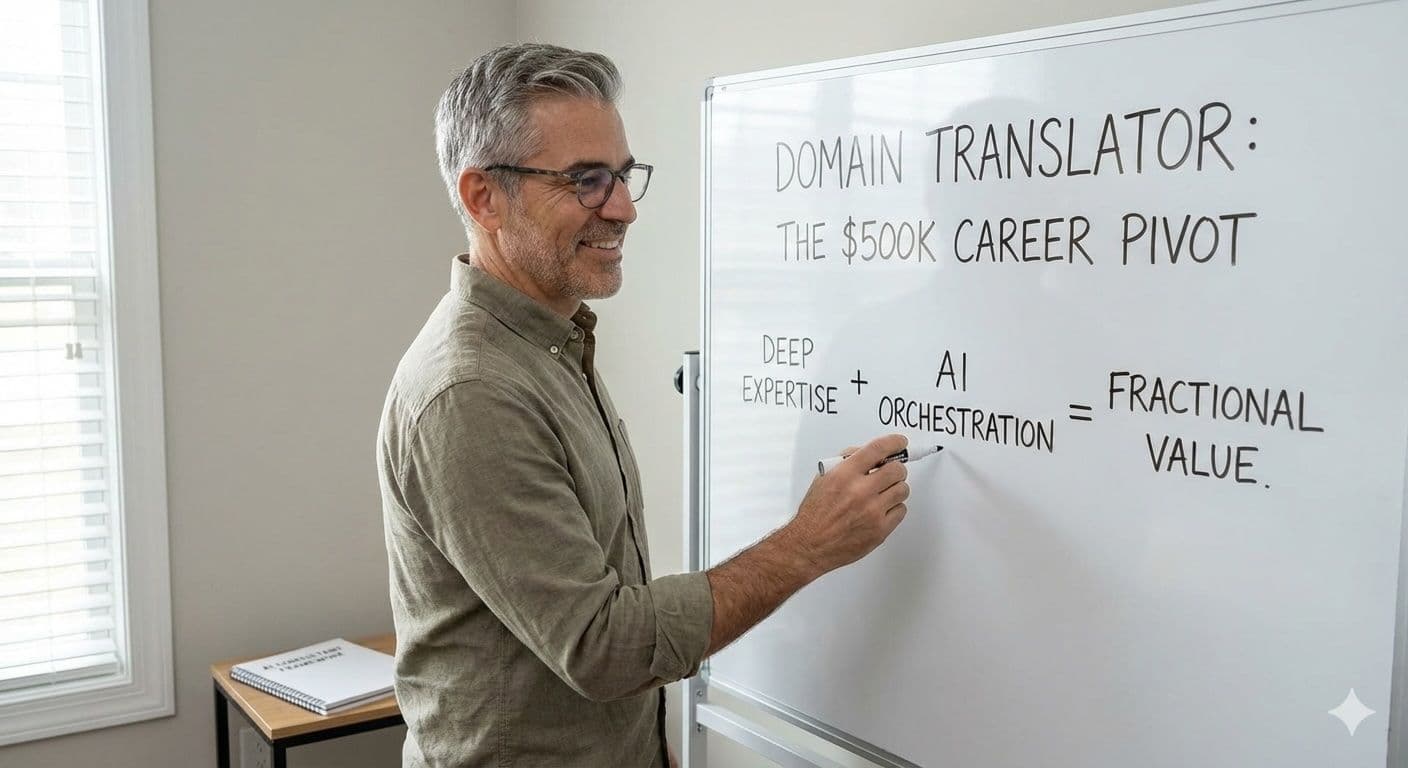
AI made your domain expertise worth 10x more. Here's the 5-step path.
How to Become a Domain Translator: The $500K Career Move Most Executives Are Missing
On a Tuesday afternoon in late 2024, a VP of Sales Operations at Salesforce got a call she wasn't expecting.
Not a recruiter. Not a client. A former colleague who'd left six months earlier to go fractional.
"I need you to look at something," the colleague said. "I'm billing $22,000 a month across two clients. One of them is a $180M SaaS company that's been trying to fix their pipeline accuracy problem for two years. I closed them in one call."
The VP asked the obvious question: "How?"
"I walked in and told them exactly what their AI forecasting tool was getting wrong — and why. Not because I'm an AI expert. Because I've seen this problem in seventeen different CRM implementations. I knew what to look for before I opened a single dashboard."
She went fractional four months later. Within her first year, she was billing more than her Salesforce base salary.
She had become what the market is now desperately searching for: a domain translator.
What Is a Domain Translator?
A domain translator sits at the intersection of three things that almost never exist in the same person.
Deep domain expertise. Twenty or more years inside a specific industry or function. You know how the machine works. You've seen it break. You've lived through the vendor promises that didn't survive contact with reality, the process changes that looked good on paper and failed in execution, the edge cases that only show up after years in the seat.
Practical AI literacy. Not engineering-level knowledge — operational knowledge. You've tested AI tools against your actual workflows. You know what they get right, what they get wrong, and where human judgment is irreplaceable.
Business translation ability. You can walk into a room of executives who are panicking about AI and tell them, in plain language, exactly what it means for their specific operation. Not theoretically. Not eventually. Right now, in their business, with their data, their team, their constraints.
This person does not exist in most companies.
AI engineers know the tools but not the business. Traditional executives know the business but not the tools. And consultants, in most cases, know neither well enough to give specific answers — just frameworks and deliverables that look impressive in a slide deck and gather dust in a shared folder.
The domain translator gives clients something completely different: hard-won, battle-tested judgment about where AI actually delivers in a specific context, and exactly what to do about it.
That judgment is worth $15,000 to $25,000 per month to the right client. Across two or three retained engagements, that math changes your life.
Why This Role Is Exploding Right Now
Every company above $10M in revenue is currently sitting in the same uncomfortable position.
They've heard the AI promises. They've watched competitors pivot. They've fielded questions from their board about AI strategy. And most of them have no concrete answer for what AI can actually do in their specific business — not in general, but in their workflows, their data, their team structures.
The people they've hired to answer that question — AI consultants, implementation partners, technology vendors — have almost universally failed to close the gap between theoretical AI capability and operational reality.
The reason is straightforward: you cannot answer "what can AI do in our revenue operations?" without having run revenue operations at scale. You cannot answer "where does AI break in our supply chain?" without having managed supply chain failure at 2 AM during peak season.
The context isn't just helpful. It's irreplaceable.
And right now, the executives who have that context — who have spent two or three decades building deep operational expertise — are sitting on an asset they're radically undervaluing. They're sending resumes. Waiting for callbacks. Competing for W2 roles in a market that has fundamentally changed.
Meanwhile, the companies they want to work for are desperately searching for someone who can actually tell them the truth about AI — someone with enough domain experience to know when the AI recommendation is right and when it's going to cost them.
This is the moment your experience becomes a different kind of asset. Not a credential for getting hired. A capability for solving problems nobody else in the room can solve.
The Five-Step Framework to Become a Domain Translator
Becoming a domain translator is not a certification program. It's a deliberate process of building and documenting something you already know — and testing it against the AI tools that are reshaping your industry.
Here's how to do it.
Step 1: Map your domain.
Start by identifying the five to seven highest-value workflows you've owned over your career. Not your job titles. Your workflows — the repeatable processes where your decisions moved money, reduced risk, or created competitive advantage.
A VP of Supply Chain might list: demand forecasting, supplier qualification, inventory positioning, logistics network design, and vendor contract negotiation.
A VP of Revenue Operations might list: CRM data governance, sales forecasting, territory planning, commission modeling, and tech stack rationalization.
A VP of HR Technology might list: HRIS implementation governance, workforce planning, compliance workflow design, talent acquisition tech selection, and change management for platform migrations.
These are your domain assets. Write them down. Be specific. The more granular you are, the more clearly you'll see your value — and the more precisely you'll be able to describe it to a client.
Step 2: Test AI against each workflow — systematically.
Take each workflow and spend two to four weeks running AI tools against real scenarios. Not reading about what AI could theoretically do. Actually doing it.
If you're in supply chain, run your historical demand data through AI forecasting models. Document where they outperform your previous approach and where they fail. Note the failure modes — what kinds of inputs break the model, what edge cases it misses, what human judgment it cannot replace.
If you're in revenue operations, test AI against actual CRM data. Run pipeline analysis, win/loss modeling, rep performance segmentation. Find out where the output is genuinely useful and where the model is confidently producing garbage.
This is not a theoretical exercise. It is the beginning of your intellectual property.
Step 3: Document the truth.
The output of Step 2 is not a tools list. It is a set of specific, defensible judgments about where AI works and where it doesn't — in your domain, in your context, with your operational experience as the filter.
Write it down. Be precise.
"AI demand forecasting performs well for SKUs with 24 or more months of clean data and performs poorly with new product introductions or promotional anomalies" is a sentence worth more than a hundred hours of generic AI consulting to the right client.
"Einstein AI in Salesforce produces reliable opportunity scoring for deals under $50K and produces unreliable scoring for enterprise deals with more than six stakeholders and a longer than 90-day cycle" is the kind of statement that closes a retainer in a single conversation.
These specific, experience-backed judgments are what separate you from every generic AI consultant on the market. They are not in any playbook. They are not available on LinkedIn. They exist because you earned them over twenty years.
Step 4: Build your delivery model.
Now ask the question that turns this into a business: what can I deliver — with AI — that would take a traditional consultant twice as long and cost three times as much?
A traditional supply chain consultant might take six weeks to deliver a demand forecasting audit. With AI tools you've already tested and know how to deploy, you deliver it in ten days. Not because the quality is lower. Because you already know what to look for, which means you're not spending four of those six weeks learning the client's business from scratch.
A traditional RevOps consultant charges $25,000 for a CRM health assessment. You deliver a more specific version in two weeks for $15,000 — and the output is more actionable because you actually understand what the data is telling you, not just how to extract it.
Your delivery model is a simple equation: your domain expertise multiplied by AI execution speed equals output that traditional consulting cannot match on timeline, price, or specificity.
Step 5: Package it fractionally.
You do not need ten clients. You need two or three companies paying $15,000 to $25,000 per month for ongoing domain translation — helping them implement AI in their operations with real, experienced oversight.
This is not project consulting. It is retained expertise. The companies that engage you are not buying a deliverable. They are buying ongoing access to someone who can answer "is this AI recommendation actually right for our situation?" with authority — because you have been in their situation for twenty years.
The fractional model works here because the need is ongoing. AI implementation is not a one-time project. It's a continuous process of testing, adjusting, governing, and re-evaluating as the tools evolve. Your clients don't need you for six weeks. They need you for twelve to twenty-four months.
Five Real Examples: What This Looks Like in Practice
The Microsoft Enterprise Sales Executive
Twenty years selling Azure and Dynamics to Fortune 500 companies. You've sat in more enterprise buying cycles than most consultants have read case studies about. You know how procurement actually makes decisions, which stakeholders matter and which ones are noise, and exactly where a deal that looks closed can fall apart in the last week.
As a domain translator, you become a fractional GTM consultant for $25M to $100M SaaS companies. You use AI to build sales playbooks, analyze competitive positioning, model territory design, and generate proposal frameworks — work that would take a traditional GTM consultant eight weeks. You deliver a first assessment in two.
Your specific edge: you know how enterprise procurement decisions get made at the level where AI-generated proposals stop working. That institutional knowledge is not in any AI model. It's in your memory. And it's exactly what your client's sales team is missing.
The Salesforce RevOps Executive
Fifteen years living inside Salesforce — implementations, migrations, org design, data governance, and one too many Einstein AI rollouts that were oversold in the boardroom and underdelivered in the field.
As a domain translator, you become a fractional RevOps consultant for companies scaling their sales operations. You use AI to audit pipeline data, surface forecasting errors, identify coaching opportunities buried in rep activity data, and model commission plan changes before they go live.
Your specific edge: you know where Salesforce's native AI is actually reliable and where it's producing confident, wrong answers. Your clients are paying their Salesforce account executive to tell them everything works. They'll pay you $18,000 a month to tell them the truth — and to fix it.
The Amazon Supply Chain Executive
Eighteen years running fulfillment operations at scale. You've debugged AI-powered routing algorithms at 11 PM on Black Friday when they failed under load. You know the exact failure modes that no vendor mentions in their demo because no vendor has ever had to live with the consequences.
As a domain translator, you become a fractional COO or supply chain consultant for manufacturers, third-party logistics companies, and retailers. You use AI to model inventory positioning, optimize carrier selection, run demand simulations, and assess supplier concentration risk.
Your specific edge: you've already made the expensive AI mistakes — at Amazon's scale. Your clients are about to make smaller versions of those same mistakes. You help them skip that tuition. That is worth significantly more than the cost of your retainer.
The Google or Meta Analytics Executive
Twelve years in performance marketing analytics at a platform that invented the targeting models everyone else copies. You understand what the algorithm actually optimizes for — and it is not always what the sales team tells your clients.
As a domain translator, you become a fractional CMO or analytics consultant for mid-market brands spending $1M to $10M annually on digital advertising. You use AI to analyze creative performance patterns, model audience segmentation strategies, run attribution analysis, and stress-test media mix models.
Your specific edge: you know how the black boxes actually work. Your clients are trusting their media agency to tell them their campaigns are efficient. You can tell them specifically why they're not — with the receipts to back it up.
The ServiceNow or Workday Implementation Executive
Fifteen years running enterprise transformation projects. You've watched AI workflow automation tools get implemented beautifully in the demo environment and fail completely in production — not because the technology was wrong but because the change management was inadequate or the organizational incentives were misaligned.
As a domain translator, you become a fractional transformation consultant for companies digitizing their HR, finance, or service operations. You use AI to map current-state workflows, identify genuine automation opportunities, and design governance frameworks that survive the first six months.
Your specific edge: you know which workflows look like easy wins on paper and will create compliance exposure or team revolt in practice. The AI readiness assessment that a Big Four firm charges $80,000 for? You deliver the operationally relevant portion in three weeks — because you've already learned the hard lessons your client is about to pay someone else to learn.
The Mistake Executives Make
The executives I talk to who dismiss this path usually say some version of the same thing: "I'm not an AI expert."
That is precisely the point.
Your clients are not looking for AI experts. They have AI experts. They're drowning in AI experts who can tell them what the technology can theoretically do but have no framework for applying it to their specific operation, their specific team, their specific risk tolerance.
What they need is someone who knows their world — and knows enough about AI to give them an honest, specific answer about where it helps and where it doesn't.
You've spent twenty years building the first half of that equation. The second half — practical AI literacy in your specific domain — takes weeks to begin and months to develop into a genuine asset. Not years. Not a degree. Not a certification.
The window for becoming a domain translator is open right now. Companies are making consequential AI decisions today, with or without the right expertise in the room. The executives who step into this role in the next twelve to eighteen months will establish a positioning that is genuinely difficult to replicate.
The ones who wait for the right time will find the market has moved on without them.
What to Do This Week
Pull up a blank document and write down the five highest-value workflows you've owned in your career. The ones where your judgment moved money. The ones where you made the call nobody else in the room could make.
Pick one. Find two or three AI tools that touch that workflow. Spend a week running them against a real scenario from your experience. Document what they get right. Document where they fail.
That documentation is the beginning of your domain translator IP. And it is the beginning of a fractional practice that does not depend on the W2 job market, the next wave of tech layoffs, or a recruiter returning your call.
If you want to talk through how this applies to your specific background — your domain, your workflows, your target market — grab a free 45-minute strategy call. We'll map out exactly what your domain translator practice could look like.
Apply for the AI Fractional Accelerator
Contact Me to discuss your specific situation and get personalized guidance.
Join My Newsletter for weekly executive job search strategies and insights.
Written by
Bill Heilmann