The Last Time This Happened, They Built Trillion-Dollar Businesses.
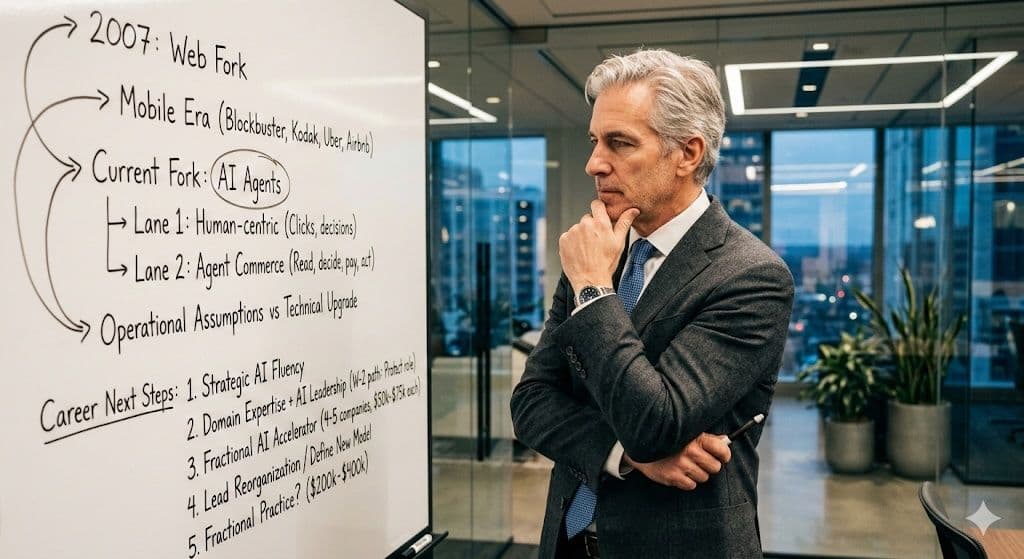
The web is forking again. Which side are you on?
The Last Time This Happened, They Built Trillion-Dollar Businesses.
In 2007, the web forked.
Desktop on one side. Mobile on the other. Same internet. Different world.
The executives who saw it early didn't just add a mobile app and call it a day. They rebuilt how their entire business worked around a customer who was now always connected, always located, always one tap away from a competitor.
The ones who treated it as a technology upgrade missed the point entirely.
By the time they figured it out, Uber was taking their lunch, Airbnb was disrupting their industry, and Instagram had stolen their customers' attention permanently.
It's happening again.
The Fork Nobody Is Talking About
Stripe rebuilt its entire payment system for AI buyers. Coinbase launched wallets designed for agents, not people. Cloudflare restructured how 20% of the internet serves content. Google, Visa, and PayPal all announced agent commerce protocols within months of each other.
Not because they coordinated. Because they all see the same fork coming.
The web is splitting into two lanes. One built for humans. One built for AI agents that read, decide, pay, and act without waiting for a human to click anything.
This isn't a feature update. It's a structural shift in how the internet works — and by extension, how every business built on top of it operates.
The companies making moves right now understand something most executives are still processing: this fork changes not just the tools they use, but the fundamental logic of how work gets done, how decisions get made, and which roles are essential versus redundant.
What the Mobile Fork Actually Taught Us
The mobile transition wasn't primarily a technology story. It was a business model story.
The companies that won didn't win because they had the best engineers or the most aggressive adoption timeline. They won because their leadership understood what the fork meant for their customer relationships, their operational assumptions, and their competitive exposure.
Blockbuster had engineers. Kodak had engineers. Borders had engineers. None of them lacked technical capability. They lacked leaders who could translate what was happening technologically into what it meant strategically — and move the organization accordingly.
The companies restructuring right now aren't just cutting headcount to reduce costs. They're rebuilding how work gets done, which functions are human, which are automated, and which require someone sitting at the intersection of both.
That intersection is where this is going.
The Role That Can't Be Automated
There is one role that neither this fork nor the next one can eliminate.
Not an engineer. Not a consultant who's never touched the tools. Not an AI vendor selling transformation packages.
The person who tells the AI what to do, catches it when it's wrong, and translates the outcome into business results the C-suite can actually act on.
Someone who spent 20 years running the workflow. Who understands where it breaks, where the edge cases live, where the data is dirty, and where the model will confidently produce the wrong answer. Someone who learned just enough AI to aim it correctly — and enough about the business to know what "correctly" means in context.
That's not a technical role. It's a leadership role with technical fluency layered on top of deep domain expertise.
Every company restructuring right now is either building this capacity or about to discover they needed to.
The Window Is Shorter Than You Think
The mobile fork gave executives years to figure out which side they were on. The transition was slow enough that even late movers could catch up with enough urgency and investment.
This fork is moving on a different timeline.
Token costs are falling 10x per year. As AI gets cheaper, companies buy more of it. Adoption accelerates. The gap between early movers and late movers compounds faster than it did in the mobile era because the underlying technology is improving faster than any previous platform shift in history.
The executives who recognized the mobile fork early didn't just survive the next decade — they defined it. They were the ones in the room when the strategy was set, when the org was redesigned, when the new business model was validated.
The ones who waited spent years explaining why their existing strategy still made sense. Some of them are still explaining.
Two Paths. One Window.
If you're in a W-2 role, the fork creates a specific opportunity: become the person your organization cannot restructure away. The leader who can take what AI produces and convert it into outcomes the business actually captures. That's a different conversation than managing a budget or running a team. It's a capability conversation — and the executives building that capability now are the ones who will be on the right side of the next reorg.
If you're considering a fractional path, the fork creates a different opportunity: four to five companies at $50K–$75K each, bringing 20 years of domain expertise plus AI fluency to problems that are too specific for Google, too small for McKinsey, and too valuable for the companies facing them to leave unsolved. That's a $200K–$400K practice built on exactly the skills you already have — with one additional layer.
The question in both cases is the same one executives faced in 2007.
Do you see the fork?
Because the question isn't whether AI is going to reshape your industry. You already know it is.
The question is whether you're the one holding the wheel — or watching someone else drive.
Ready to Figure Out Which Side of the Fork You're On?
Written by
Bill Heilmann