Why One W-2 Is Riskier Than Multiple Clients: The New Career Math for Tech Professionals
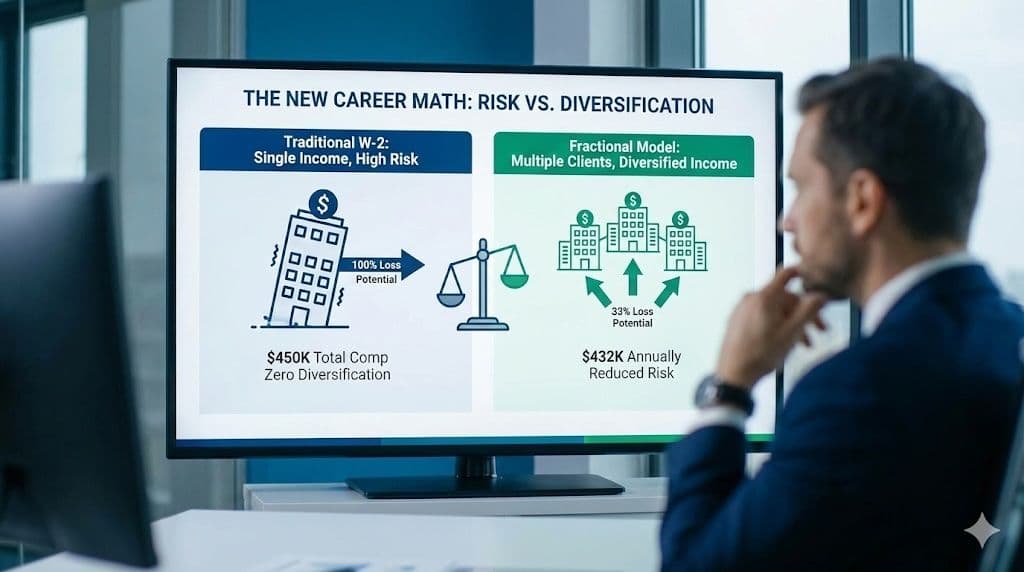
One income source at $450K or three clients at $144K each- which is better?
Why One W-2 Is Riskier Than Multiple Clients: The New Career Math for Tech Professionals
Most people think having one full-time job is safer than having multiple clients.
It's intuitive. One stable paycheck every two weeks. Benefits. Predictability. The comfort of organizational structure.
But when you actually do the math—especially in late 2025 with AI-driven transformation accelerating—the traditional W-2 model is objectively riskier than a diversified client portfolio.
Here's the career math that changes everything.
The Traditional W-2 Risk Profile
Let's start with what most senior tech professionals have:
The Standard Setup:
- Total compensation: $450K
- Income sources: 1 (single employer)
- Diversification: 0%
- Control: Minimal (subject to company decisions)
- Notice period: 2-4 weeks (or none in restructures)
The Risk Calculation:
If you keep your job:
- Income: $450K annually
- Status: Stable (until it's not)
If you lose your job:
- Income: $0 immediately (minus severance)
- Severance: 3-6 months typical
- Time to replacement: 6-9 months average
- Income during search: $0 (after severance ends)
- Savings burn rate: $15K-$25K monthly
The Math:
Month 1-3: Severance covers expenses
Month 4-9: Burning $15K-$25K monthly = $90K-$150K savings depletion
Total financial impact: $90K-$150K minimum, plus stress of $0 income
Single point of failure: If one thing breaks (your job), your entire income disappears.
The Fractional Client Risk Profile
Now let's look at the diversified model:
The Fractional Setup:
- Client 1: $12K/month (25% capacity)
- Client 2: $12K/month (25% capacity)
- Client 3: $12K/month (25% capacity)
- Total: $36K/month = $432K annually
- Income sources: 3
- Diversification: 100%
- Control: High (you choose clients)
- Notice period: Varies by contract (typically 30-60 days)
The Risk Calculation:
If you keep all three clients:
- Income: $432K annually
- Status: Stable with three points of stability
If you lose one client:
- Income: $24K/month = $288K annually
- Drop: 33% reduction, not 100%
- Recovery: Add one new client at $12K/month
- Time to replacement: 1-3 months typically
- Income during search: Still earning $24K/month
The Math:
Lose one client: Income drops to $288K (still substantial)
Land replacement in 2 months: Back to $432K
Financial impact: ~$24K temporary reduction, no savings depletion
Distributed risk: If one thing breaks (one client), you still have 66% of your income.
Which Model Is Actually Riskier?
Let's compare them side by side:
Scenario 1: You Lose Your Income Source
W-2 Professional:
- Loses job
- Income: $0 immediately
- Must find new job quickly or burn savings
- Average time: 6-9 months
- Financial damage: $90K-$150K
- Psychological state: Panic, desperation
- Negotiating position: Weak
Fractional Professional:
- Loses one client (33% of income)
- Income: Still $24K/month
- Can search strategically for replacement
- Average time: 1-3 months
- Financial damage: $12K-$36K
- Psychological state: Manageable concern
- Negotiating position: Strong
Which is riskier? The one that drops to $0 or the one that maintains $288K?
Scenario 2: Market Disruption
W-2 Professional in restructure:
- Company eliminates role due to AI
- No similar roles available in market
- Must pivot to different role/level
- May take 25-40% pay cut
- Timeline: 6-12 months
- Total impact: $150K-$300K+ over 2-3 years
Fractional Professional in market shift:
- One industry vertical struggles
- Loses one client in that vertical
- Pivots to different industry with other clients
- Income: Still $288K while replacing
- Timeline: 2-4 months
- Total impact: $24K-$48K
Which is riskier? The complete dependence on one industry/company or diversification across three?
Scenario 3: Personal or Family Emergency
W-2 Professional needs flexibility:
- Family emergency requires 3 months reduced work
- Options: FMLA (unpaid), quit, or struggle through
- If unpaid leave: $0 income for 3 months
- Risk: May lose job entirely
- Financial impact: $112K (3 months lost income)
Fractional Professional needs flexibility:
- Family emergency requires reduced capacity
- Options: Drop to 2 clients temporarily, reduce hours with all three
- If drops one client: $288K annual income continues
- Risk: Minimal, can rebuild after emergency
- Financial impact: $36K (if drops one client for 3 months)
Which is riskier? The model with no flexibility or the one where you control your capacity?
The Hidden Risks of W-2 Dependence
Beyond the obvious income risk, single W-2 dependence creates several hidden vulnerabilities:
Hidden Risk 1: Identity Dependence
W-2 model:
- Identity tied to title and company
- Self-worth linked to organizational position
- Losing job = identity crisis
- "I don't know who I am without my badge"
Fractional model:
- Identity tied to problems you solve
- Self-worth based on value you create
- Losing client = business development
- "I help companies scale, my clients change but my value doesn't"
Hidden Risk 2: Market Invisibility
W-2 model:
- Invisible outside your company
- Network atrophies over time
- Skills may become company-specific
- Must rebuild everything when job searching
Fractional model:
- Visible across multiple companies
- Constantly building network
- Skills stay market-relevant
- Already positioned for next opportunity
Hidden Risk 3: Compensation Ceiling
W-2 model:
- Capped by company comp bands
- Annual raises: 3-7% typical
- Promotion required for significant increase
- Subject to budget constraints
Fractional model:
- Set your own rates
- Raise rates: 10-20% annually
- Scale income by adding clients
- No artificial ceiling
Hidden Risk 4: Skill Atrophy
W-2 model:
- Deep expertise in one company's systems
- May become increasingly company-specific
- "We do it this way here" thinking
- Less transferable over time
Fractional model:
- Broad expertise across multiple companies
- Constantly learning different approaches
- "Here's what works across contexts" thinking
- More transferable over time
Hidden Risk 5: Forced Timing
W-2 model:
- Company decides when you leave (restructure, layoff)
- You react on their timeline
- Must find next role when they say
- No control over timing
Fractional model:
- You decide which clients to keep/drop
- Proactive choices on your timeline
- Replace clients when you choose
- Complete control over timing
When you add up all these hidden risks, W-2 dependence looks increasingly fragile.
The Diversification Premium
Here's what most people miss: Diversification actually increases your total compensation over time.
Example: Five-Year Comparison
Year 1:
W-2 Professional: $450K
Fractional Professional: $432K (3 clients at $12K/month)
Year 2:
W-2: $472K (5% raise)
Fractional: $475K (raised rates 10% across all clients)
Year 3:
W-2: $496K (5% raise)
Fractional: $522K (raised rates 10% again)
Year 4:
W-2: $496K (promotion freeze, no raise)
Fractional: $574K (raised rates, added 4th client part-time)
Year 5:
W-2: $521K (finally got 5% raise)
Fractional: $660K (established reputation, premium rates, 4 clients)
Five-year total:
W-2: $2,435K
Fractional: $2,663K
Difference: $228K over five years, plus the fractional professional has more control and less risk.
The Transitional Risk Calculation
"But doesn't starting fractional create transition risk?"
Let's compare the transition risks:
Transition 1: W-2 to Unemployment to W-2
Starting point: $450K W-2 -Event:* Laid off -Transition period:* 6-9 months job search -Interim income:* $0 (after severance) -Financial impact:* $90K-$150K savings burn -New position:* $380K (17% pay cut due to desperation) -Total cost:* $150K-$200K over transition year
Transition 2: W-2 to Fractional (Gradual)
Starting point: $450K W-2 -Month 1-6:* Build first client at $8K/month while employed -Month 7-12:* Add second client at $10K/month while employed -Month 13:* Give notice, go full fractional with $18K/month base -Month 14-15:* Add third client at $12K/month -Month 16+:* $40K/month = $480K annually
Financial impact: $0 (income maintained or increased throughout) -Total gain:* $30K over transition year
Which transition is riskier?
The Control Premium
Beyond income and risk, the fractional model offers something W-2 never can: control.
What You Control in Fractional Model:
Your rates:
- Set what you charge
- Raise rates based on value
- Premium pricing for premium expertise
Your clients:
- Choose who you work with
- Fire bad-fit clients
- Build portfolio of ideal engagements
Your capacity:
- Scale up or down as desired
- Take breaks between clients
- Control your own calendar
Your focus:
- Work only on strategic value-add
- Eliminate busywork and politics
- Spend time on what matters
Your location:
- Work from anywhere
- No commute requirements
- True location independence
What You Control in W-2 Model:
Your... uh...
- How you do the job (within constraints)
- What coffee you drink
- That's about it
The control premium is worth tens of thousands annually in quality of life alone.
The Real Risk Isn't Fractional—It's Dependence
Here's what I'm seeing with senior tech professionals in late 2025:
The ones who feel most at risk:
- 100% income from one W-2
- No alternative income streams
- Haven't tested fractional model
- Complete dependence on single employer
- Hoping nothing changes
The ones who feel most secure:
- 60-80% income from primary source
- 20-40% from alternative streams
- Actively building fractional practice
- Diversified across multiple clients/sources
- Prepared for change
The paradox: The "risky" fractional model creates more actual security than the "safe" W-2 model.
How to De-Risk Your Career Without Quitting
You don't have to quit your W-2 tomorrow to reduce risk. Here's the gradual transition:
Phase 1: Test While Employed (Months 1-6)
Goal: Prove you can generate fractional income
Actions:
- Land one advisory or fractional client at $5K-$8K/month
- Work 10-15 hours monthly alongside W-2
- Deliver exceptional value
- Get testimonial
Risk reduction:
- Income now diversified (85% W-2, 15% fractional)
- Proof of concept established
- If you lose W-2, you have foundation
Phase 2: Build Foundation (Months 7-12)
Goal: Establish sustainable fractional base
Actions:
- Add second client at $8K-$10K/month
- Total fractional: $13K-$18K monthly
- Continue W-2 at full capacity
- Document your frameworks and approaches
Risk reduction:
- Income diversified (70% W-2, 30% fractional)
- Could survive on fractional alone if needed
- Building reputation and client base
Phase 3: Create Optionality (Months 13-18)
Goal: Reach decision point with real options
Actions:
- Add third client or expand existing
- Fractional income: $20K-$30K monthly
- Decide: Stay W-2 + fractional, or go full fractional
- Either choice is from position of strength
Risk reduction:
- Income diversified (50% W-2, 50% fractional) OR
- Full fractional at $240K-$360K annually
- Complete optionality, zero dependence
Timeline: 18 months to go from 100% W-2 risk to complete diversification.
The Bottom Line
Let's return to the original question: Which is riskier?
One W-2 at $450K:
- Single income source
- Drops to $0 if lost
- 6-9 month replacement time
- $90K-$150K financial damage
- No control over timing
- Forced to accept what's available
- Hidden risks: identity crisis, market invisibility, compensation ceiling
Three clients at $144K each ($432K total):
- Three income sources
- Drops to $288K if one lost
- 1-3 month replacement time
- $12K-$36K financial damage
- Complete control over timing
- Selective about replacements
- Hidden benefits: diverse experience, market visibility, unlimited ceiling
The math is clear: Diversification is less risky, not more.
But there's more:
- Fractional income grows faster (10-20% annual vs 3-7%)
- You control rates, clients, and capacity
- Skills stay market-relevant across companies
- Network compounds across engagements
- Identity independent of any employer
I'm not saying everyone should quit their W-2 tomorrow.
But the professionals building optionality are testing fractional work while still employed:
- One advisory client
- One part-time consulting role
- Building proof before they need it
They're not abandoning stability. They're creating actual stability through diversification.
Because in late 2025, with AI transformation accelerating and January restructures coming:
One income source is the riskiest position of all.
Multiple income streams is the new safety net.
Which position are you building toward?
Ready to Build Real Income Diversification?
If you're realizing that 100% W-2 dependence is riskier than you thought and want to systematically build fractional income while employed, I can help you develop a transition plan.
Book a Strategy Call to discuss testing fractional work while maintaining your W-2.
Download The Headhunter's Playbook for strategies that work in any career model.
Join My Newsletter for daily insights on building career resilience and income diversification.
Written by
Bill Heilmann